
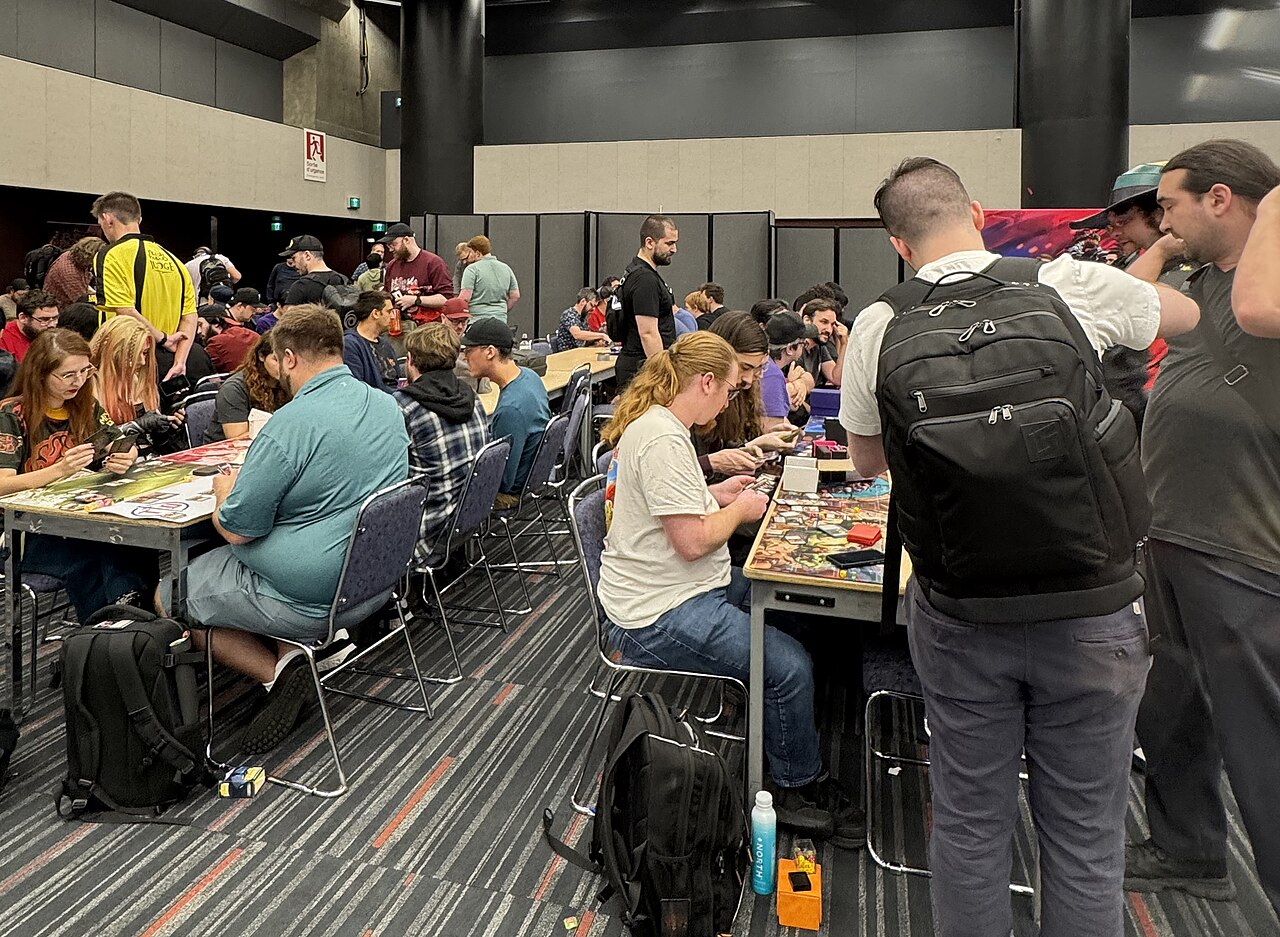
A teaching example can reveal information on purpose
Learning a hidden-information game presents a small puzzle: a new player needs to see why a choice works, yet the normal game may depend on not seeing everyone’s options. An open practice example can make the mechanism visible before the concealed version begins. Wizards of the Coast’s official Magic learning material identifies a player’s hand as information normally kept from the opponent, and its teaching resources describe structured learning aids. Those are primary examples of the teaching problem. The exercise here uses an entirely invented three-card game, so its rules and practice sequence do not claim to reproduce a named product or a convention’s actual program.
Define the real information boundary
Imagine a game called Three Lanterns. Each player holds three numbered cards privately. On a turn, a player selects one card face down, and everyone reveals the chosen cards together. The highest revealed number earns a point. For this explanatory example, assume all numbers differ and no additional powers exist. The private hand is part of the normal game’s structure; the revealed card becomes shared information at a stated moment. Identifying that boundary is the first teaching step. Otherwise, a learner might understand the numerical comparison yet miss that opponents do not know all the alternatives available before the reveal.
Use an open practice hand with a clear label
For a teaching round, place the hands face up and explicitly call it an open practice example. One person has cards one, four and seven; another has two, five and eight. Everyone can now see the possible comparisons. This changes the information available, so it is not a normal scored round under the stated rules. Labeling the change prevents the learner from carrying the wrong assumption into regular play. The open example serves a specific purpose: it makes the consequences of selecting different numbers visible. It does not need to imitate the full uncertainty of the game at the same time.
Explain one choice rather than every possible strategy
Suppose the first player selects seven and the second selects five. Reveal and compare those two numbers, then show where the selected cards go under the teaching procedure. Keep the explanation focused on selection, reveal and comparison. A complete strategic discussion could overwhelm the basic mechanism before the learner has followed one turn. Conversely, saying seven wins without showing which cards were chosen leaves the selection process unclear. The useful unit is a small cause-and-effect chain. That chain can be understood without claiming that the demonstrated choice is optimal across every later situation or that a particular number always wins.
Change one variable to expose a consequence
Repeat the comparison with the second player selecting eight instead of five. The first player’s seven now loses the comparison. The only changed element is the selected opposing card, making the reason for the different outcome easy to see. Repeating the comparison makes the effect of the changed choice visible. In an actual game, special rules could make such a comparison more complicated, so the presenter’s official learning materials should govern it. The principle is to keep enough of the situation fixed that the learner can identify which change produced the new result.
Restore the concealed information explicitly
Before beginning the normal version of Three Lanterns, turn the remaining hands private again and state what other players may see. The learner now moves from understanding the comparison to making a choice without complete knowledge. That transition is part of the exercise, not a minor presentation detail. In a real convention demonstration, ask whether the face-up cards are an instructional aid or part of the normal rules. A sample table may intentionally reveal information to explain a mechanism. Treating that display as the standard competitive state could lead to an inaccurate description of the game after only a brief observation.
Distinguish assistance from revealing an opponent’s options
A teacher can explain where an action is permitted or what a symbol means without necessarily exposing hidden cards. The appropriate boundary depends on the game and the kind of session being run. In the exercise, explaining when the reveal occurs differs from announcing another player’s private choices beforehand. For an actual public table, the presenter can identify the learning arrangement. Wizards’ teaching resources provide examples of publisher-created aids, but they do not establish one universal practice for every game. Preserve the distinction between rules instruction, an open example and assistance during an ordinary round.
Look for a learning sequence you can describe
A useful exhibit note might say: the presenter first showed open sample hands, compared two choices, then restored private hands for the next round. That records the teaching sequence rather than ranking the game’s complexity or the teacher’s ability from a short sample. If the demonstration remains open throughout, state that limitation when describing what you learned. When watching a teaching demonstration, identify the moment when instructional visibility changes to ordinary hidden information. That transition explains what the learner has practiced and what remains new when the regular version begins, even in a very short sample.
Continue exploring
Explore related events
Current facts come from the directory. Follow the exact listing for admission, venue information and the official source.
Gen Con Indy 2027 · Aug 5 – Aug 8, 2027 · scheduled · 2027 dates announced; badge-sale schedule requires current organizer confirmation
Sources and further reading
Source review: 2026-10-12. Examples identified as hypothetical are original illustrations.
An independently researched feature. Worked examples are illustrative; photographs identify their archive or collection context.
Find your next event →