
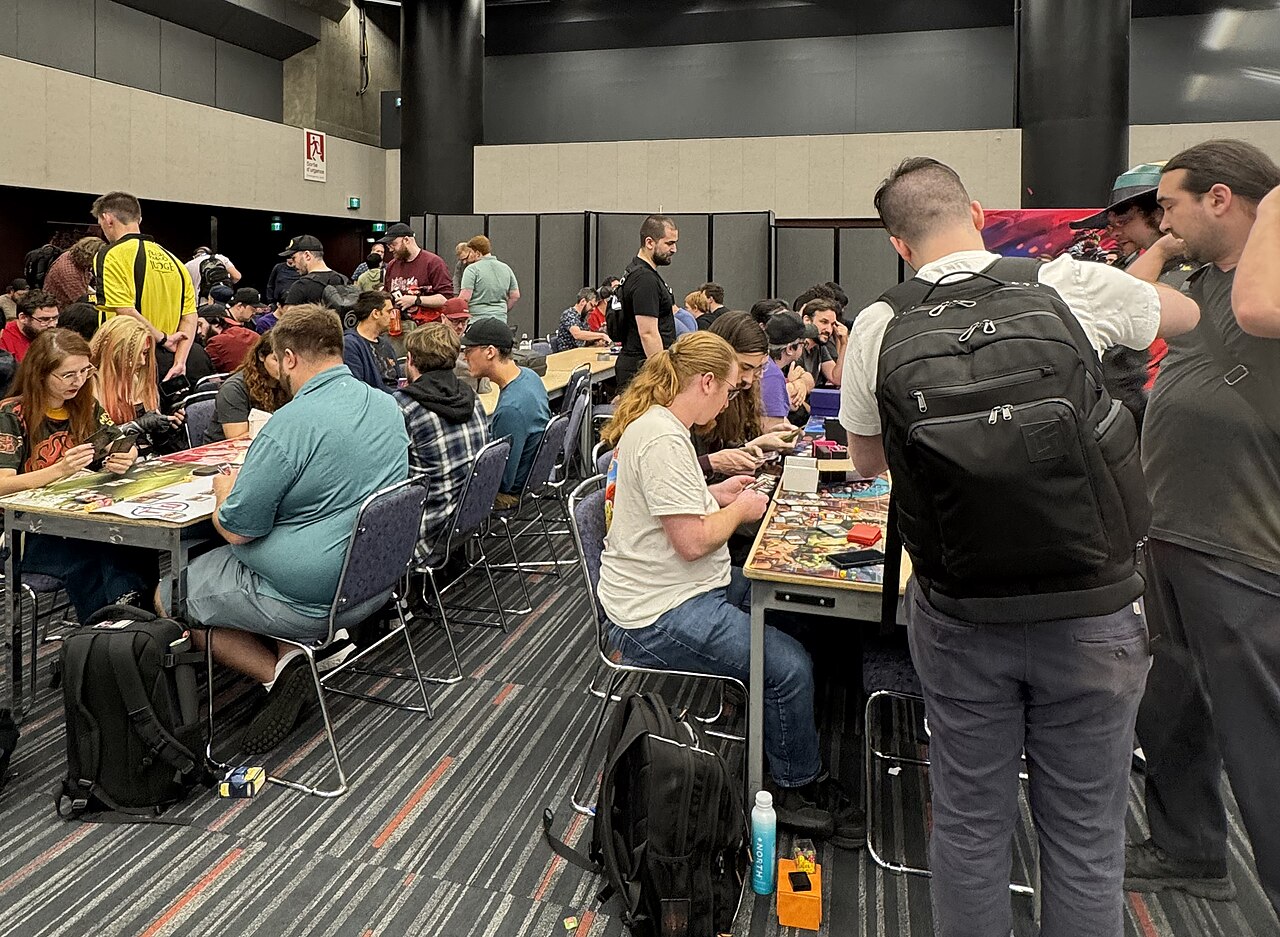
Structuring the Demonstration Table
Introducing visitors to a trading-card game at a public exhibition requires a clean, predictable setup. According to official rules for Magic: The Gathering, setting up the play area begins when each participant shuffles their deck, places it face down, and draws a hand of seven cards from their library. If a player is dissatisfied with their initial cards, they may take a mulligan to refresh their hand. Demonstrators must also establish a clear method to track life totals, since reducing an opponent's life total to zero is the primary win condition. By organizing these physical elements before any cards are played, organizers help novices focus on learning core mechanics rather than searching for components across a cluttered table.
Guiding Players Through Turn Structure
Once the initial layout is established, introducing the sequence of a turn prevents cognitive overload for new participants. Official game guides divide every turn into five distinct phases: the beginning phase, first main phase, combat phase, second main phase, and end step. During the beginning phase, players untap their cards, resolve any active upkeep effects, and draw a card. Demonstrators can use this structured progression to show how actions flow logically from preparation to execution. Explaining that the player who goes first skips their initial draw adds a concrete tactical detail that helps beginners understand turn-one balance without feeling rushed by complex rule interactions or rapid table pacing.
Distinguishing Land Cards and Mana Generation
A common point of confusion during introductory sessions involves how resources are generated to cast spells. Official instructional materials clarify that land cards are not spells; instead, players may play one land card during each of their turns for free. To generate the necessary mana required to cast active spells, players must tap these lands, producing the specific colors indicated on the card icons. By separating resource generation from spellcasting, demonstrators can clearly show that generic mana costs, represented by numerical symbols, demand deliberate resource management. This separation helps exhibition visitors grasp why hand composition and land placement dictate every subsequent strategic choice on the battlefield.
Casting Permanent Versus Temporary Spells
After generating adequate mana, players learn to cast spells by paying costs matching the symbols located in the top right corner of each card. Official gameplay rules differentiate spells by where they reside after resolution. Permanent spells, such as creatures, artifacts, and enchantments, remain on the battlefield to influence future turns. In contrast, non-permanent cards like instants and sorceries go directly to the graveyard after their effects resolve. Demonstrators should highlight this physical distinction on the table layout, showing novices how persistent threats differ from one-shot utility effects. Maintaining this visual clarity prevents beginners from confusing active battlefield assets with spent resources.
Breaking Down Combat Phases Step by Step
Combat represents one of the most mechanically dense segments of a trading-card demonstration, requiring a methodical explanation. Official documentation breaks the combat phase into three strict sequential steps: declare attackers, declare blockers, and calculate damage. During the first step, the attacking player chooses which creatures will attack and taps them. Next, the defending player selects untapped creatures to block those attackers. Finally, damage is calculated simultaneously, and any creature sustaining damage equal to or greater than its toughness is sent to the graveyard. Walking visitors through these discrete steps ensures they see combat as a predictable puzzle rather than an intimidating clash of unstructured rules.
Utilizing Instructional Tools at Demo Stations
Successful public demonstrations rely on physical reference aids that support both the instructor and the participant. Organizer resources provided by retail networks suggest using laminated learn-to-play flip guides and quick start guides to create an intuitive, face-to-face experience. Taping rules reference cards flat on the demonstration table gives visitors an immediate, independent way to check keyword abilities and turn steps without interrupting the flow of the game. Providing sample decks or quick-start materials to take home further extends the educational value, transforming a brief exhibition interaction into a lasting hobby engagement supported by clear foundational rules.
Designing Accessible Experiences for New Audiences
When organizing a public gaming exhibit, event planners must balance comprehensive rule education with approachable pacing. Relying on structured introductory products like foundational card sets allows demonstrators to showcase the game's historic depth without overwhelming participants with advanced mechanics from decades of expansions. By focusing initial conversations on basic setup, turn phases, and straightforward combat math, staff create a welcoming environment. Visitors leave the demonstration table not just having watched a match, but having personally executed the foundational loops that define trading-card game strategy in competitive and casual spaces alike.
How this article was prepared
This article used automated drafting and checks against the linked sources. Its photograph is identified and credited separately. Please use our correction link to report an error.
Continue exploring
Explore related events
Current facts come from the directory. Follow the exact listing for admission, venue information and the official source.
Delaware Sports Cards and TCG Show 2026 · Nov 21, 2026 · scheduled · Public admission — check promoter for updates
Maximum Card Show Santa Clara November 2026 · Nov 21 – Nov 22, 2026 · scheduled · Public attendance announced — check current organizer details
Meeplefest 2026: Classics Rock! · Nov 20 – Nov 22, 2026 · scheduled · Public attendance announced — check current organizer details
Tidewater Waldorf Sports Card and Collectibles Show 2026 · Nov 21, 2026 · scheduled · Public admission announced — check current organizer information
Sources and further reading
Source review: 2026-10-24. Examples identified as hypothetical are original illustrations.
An independently researched feature. Worked examples are illustrative; photographs identify their archive or collection context.
Find your next event →










