
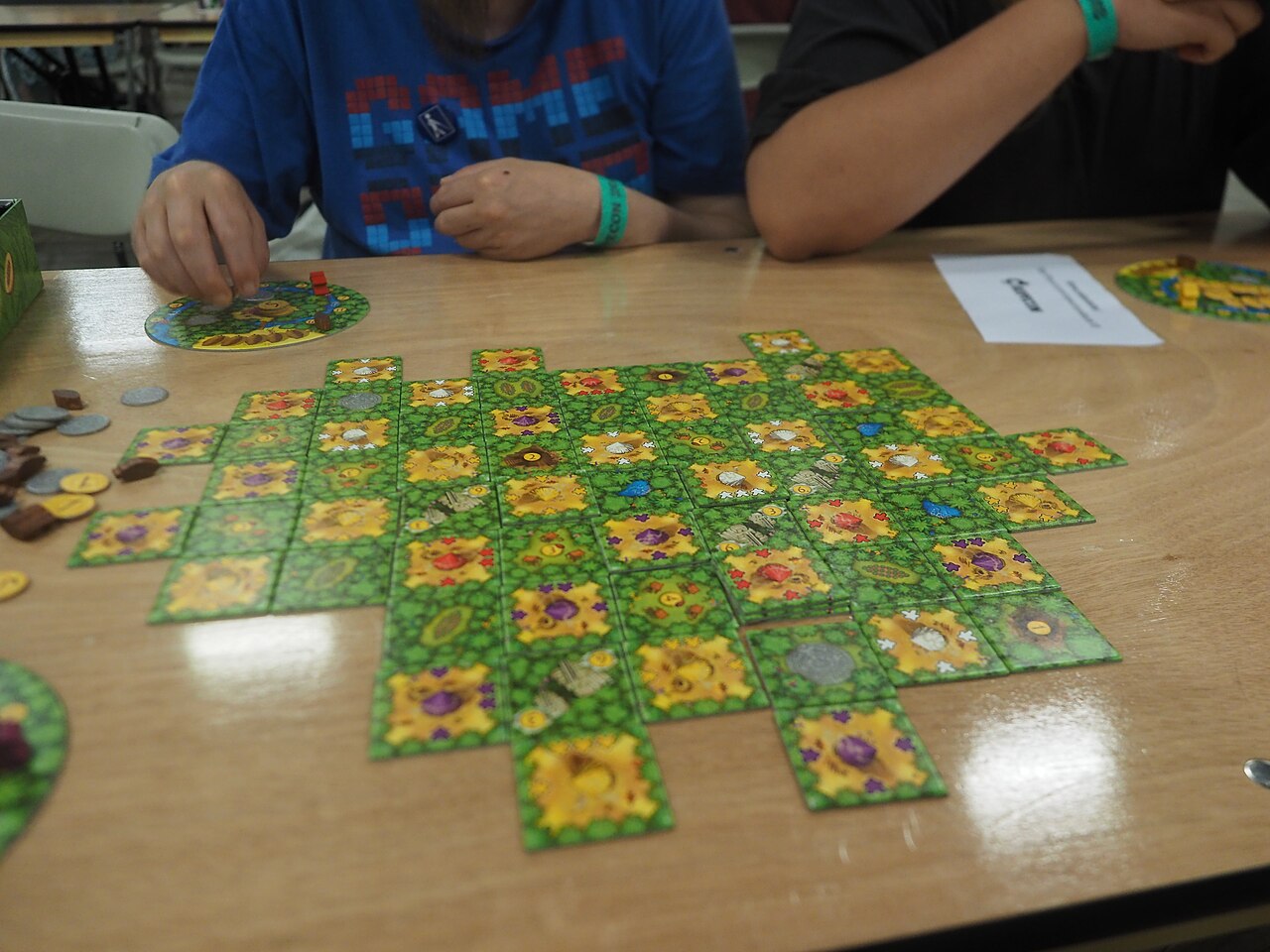
A shared goal does not make every decision shared
Cooperative games ask players to work toward a common outcome, but they can distribute information and choices in very different ways. Some expose nearly everything to the table; others limit what can be communicated. At a gaming convention, that distinction can be more revealing than the label cooperative alone. Thames & Kosmos’s official rulebook for The Crew: Mission Deep Sea supplies a real example of a cooperative game with communication rules. An invented three-player puzzle makes shared knowledge, private information and decision ownership visible.
Map who can see what
Imagine a game called Signal Garden. Three players share a board showing three empty spaces. Each player privately holds one card marked with a different symbol, and the group must place the symbols in a particular order. The visible board is shared information; the held cards are private information. This distinction matters before any strategy discussion begins. A person looking across a convention table might see a common board and assume that all relevant facts are visible. Ask what each player is entitled to know under the displayed rules, rather than equating a shared objective with a completely shared view of the game state.
Separate information from permission to communicate
A player may know something yet be allowed to reveal it only in a particular way. In the Signal Garden, each person can show one approved clue token but cannot name their card’s symbol. That restriction creates a puzzle about interpreting limited signals. It is not merely an inconvenience that a helpful teacher should erase. The Crew’s publisher rulebook is a primary example of communication being an explicit game system. Use the actual game’s wording when discussing a real demonstration. The clue-token rule here exists only to illustrate the difference between having information and being permitted to transmit all of it freely.
Find the decision owner
Cooperation can involve discussion without making every action a vote. In the game, the active player decides which empty space receives their card after hearing permitted clues. Other players can contribute information within the rules, but the active player owns that choice. A different version could let the group vote instead. These versions create different participation patterns even if their goal and components are identical. During an exhibit demonstration, notice whether a player selects an action, a group selects it or a rule determines it automatically. That observation is more specific than simply describing the game as social or teamwork-based.
Compare two versions of the same puzzle
Version A of Signal Garden reveals all three cards from the beginning and lets everyone discuss freely. Version B keeps cards private and uses the limited clues. In A, the challenge might come from planning a sequence among known possibilities. In B, interpreting another person’s clue becomes part of the challenge. Neither version is inherently more cooperative merely because it contains more conversation. Both share an outcome, but their information structures differ. This controlled comparison helps a visitor identify the source of the experience they are seeing. It does not make claims about difficulty, play time or enjoyment of an actual published game.
Notice what happens when one person directs everything
A confident player may see a strong solution in a fully open game. If they tell everyone exactly what to do, the group might progress while some participants have fewer meaningful decisions. That is a possible interaction, not proof that open-information games always produce it. In a limited-information system, the same person may lack the knowledge needed to direct every move. Other systems may preserve individual choices in different ways. Describe the mechanism you can observe rather than diagnosing the people at a public table. A short demonstration is too little evidence to establish how every group will experience the game.
Failure can come from different sources
In Signal Garden, an incorrect placement could result from an ambiguous clue, a mistaken interpretation or a choice made despite a clear clue. Those are different events. A shared loss does not erase their distinctions, and identifying them can explain what players are learning. An official rulebook may specify which information becomes public after a round or how another attempt begins. Do not import a reset procedure from one game into another. For the example, revealing all cards afterward would allow players to compare their assumptions with the actual symbols. That debrief changes what the group can learn from the failed attempt.
Describe cooperation as a structure
A useful convention note might say: the objective is shared, hands are private, clues are restricted and the active player selects the placement. Four concrete relationships communicate more than the word cooperative alone. If a demonstration uses a shortened tutorial, distinguish that presentation from the full game’s documented information rules. At a cooperative-game demonstration, notice one moment when a player knows more than they may say, or decides something the group cannot decide for them. That moment can reveal how the game distributes participation more clearly than its shared-goal label.
Continue exploring
Explore related events
Current facts come from the directory. Follow the exact listing for admission, venue information and the official source.
Gen Con Indy 2027 · Aug 5 – Aug 8, 2027 · scheduled · 2027 dates announced; badge-sale schedule requires current organizer confirmation
Sources and further reading
Source review: 2026-10-12. Examples identified as hypothetical are original illustrations.
An independently researched feature. Worked examples are illustrative; photographs identify their archive or collection context.
Find your next event →