
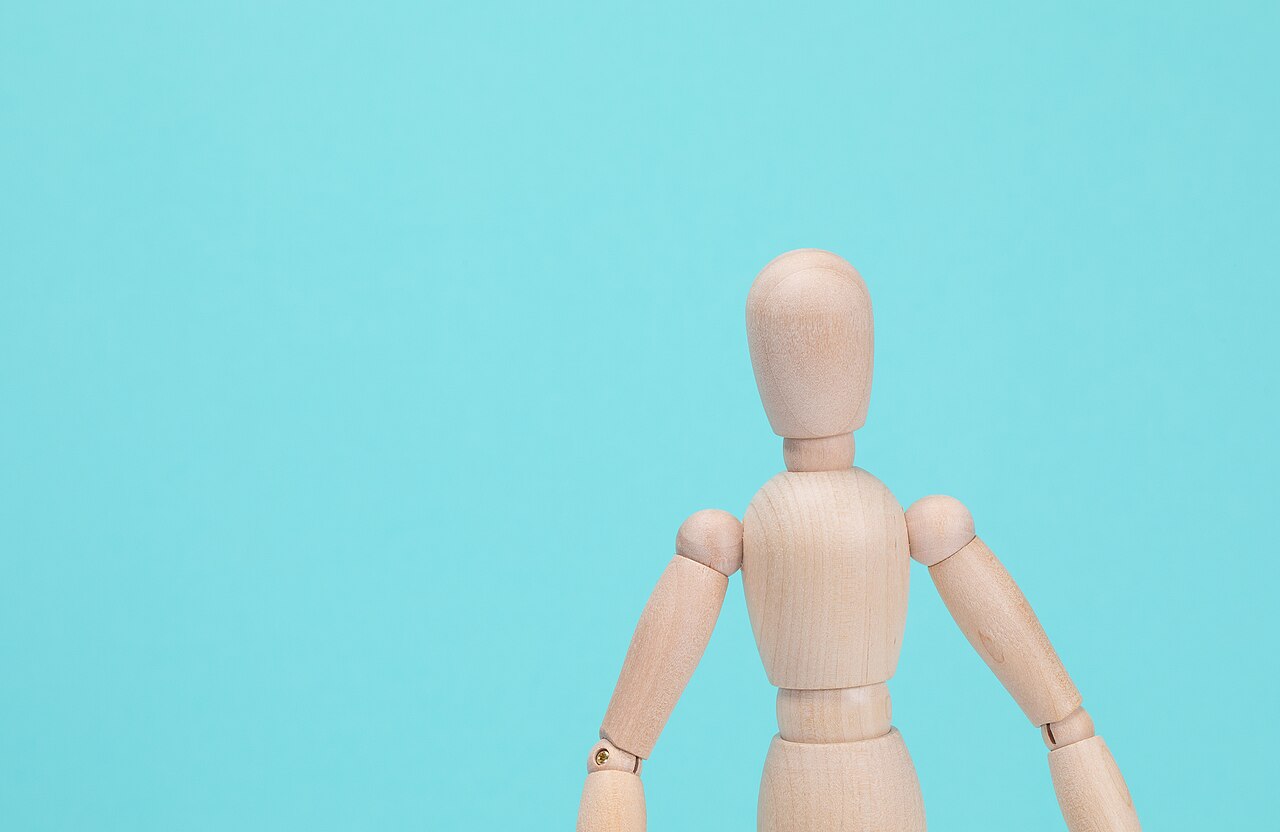
A posed figure combines a design and a presentation
An articulated collectible at a convention can look expressive while standing completely still. Its pose depends on the relationship among its joints, body shapes, accessories and any visible support. Understanding those elements gives a visitor a vocabulary beyond counting moving parts or calling a figure realistic. Hasbro’s product descriptions use articulation as a feature of poseable figures, while Max Factory’s drawing-doll page describes a figure and its support stand. Those are primary examples of manufacturer language. An entirely fictional character provides a reference for comparing pose, outline, accessories and visible support.
Identify the object before evaluating the pose
A product label may describe an articulated figure, a fixed statue, a drawing reference or another kind of object. Similar appearances do not prove the same construction. In a display, a character called the Harbor Messenger appears in two forms: one fixed in a running pose and another articulated and presented in a standing pose. The running statue does not necessarily have more movement just because its image looks dynamic. The articulated figure’s quiet stance does not tell you how many poses it can assume. Start with the maker’s description, then distinguish the object’s construction from the particular presentation selected for the exhibit.
A joint is a relationship between parts
Articulation allows identified parts to change their relationship within the design’s intended movement. A display label can identify joint locations or describe articulation, but the total count does not explain every available direction or range. In the Harbor Messenger, two different figures could have the same number of stated articulation points while using different body proportions or joint designs. Their visible poses might therefore differ. Avoid treating a count as a complete performance specification. The specific manufacturer’s documentation is the stronger reference for a product’s construction; a visitor’s observation describes only what the presented figure makes visible.
The silhouette changes with the pose
Imagine the Messenger standing with both arms near the body, then imagine the same character depicted with one arm extending outward. The second silhouette separates the arm from the torso and can make the gesture easier to distinguish from a distance. That is an observation about outline, not an instruction to reposition an exhibit. A posed display can also emphasize a character’s costume or accessory by placing it outside the body’s main shape. Notice which features are visible and which overlap. A detailed figure may conceal some of its most intricate features in a particular pose, while a simpler outline can communicate a clear action.
Support is part of the presentation evidence
A stand or support can help present a pose that the object is not shown holding independently. Max Factory’s primary drawing-doll description specifically identifies an articulated support stand, illustrating that support can be an acknowledged part of a figure system. In an exhibit, record what is visible rather than assuming a figure balances unaided. A transparent support may be less noticeable than a dark one, but it still belongs to the presented setup. Conversely, an unseen support should not be assumed merely because a pose looks unusual. The label and the observable arrangement establish the available evidence.
Accessories change the visual story
An object held or placed nearby can alter the apparent action. In the display, the Harbor Messenger carries a sealed parcel in one presentation and stands beside an open satchel in another. Those props suggest different moments without requiring changes to the underlying character design. The inference remains a reading of the display, not proof of a particular storyline. An accessory list identifies what a product supplies; a posed scene shows what the exhibitor selected for that arrangement. Keep those functions separate. A display containing additional scenic objects does not automatically establish that every one belongs to the packaged figure.
Multiple views answer different questions
A front view can show expression and costume detail; a side or rear view can reveal other relationships among the forms. At a display, use the views that are actually offered and the creator’s authorized images when available. Do not infer a hidden joint or attachment from a photograph that does not show it. In the Messenger, an arm overlapping the torso in front view might be clearly separated in a side view. The object has not changed; the available visual evidence has. This is why a single publicity image may be insufficient for describing the complete physical construction or the full arrangement of a posed display.
Describe the presentation rather than inventing a test
A precise exhibit note might say: the figure is labeled articulated, its extended arm changes the silhouette, and a visible stand supports the displayed pose. Each part connects a description with evidence. That is more useful than claiming the figure has superior balance or unlimited movement without a documented comparison. Collectibles and gaming events can present fixed sculptures, articulated figures and reference objects together, making their labels especially valuable. Let the maker’s information describe the product and your observations describe the display. The resulting account respects both the designed object and the particular visual story its presentation tells.
Continue exploring
Explore related events
Current facts come from the directory. Follow the exact listing for admission, venue information and the official source.
Gen Con Indy 2027 · Aug 5 – Aug 8, 2027 · scheduled · 2027 dates announced; badge-sale schedule requires current organizer confirmation
Sources and further reading
- Hasbro: Miles Morales figure, articulation description ↗
- Max Factory: Nishimura Style Drawing Doll and support stand ↗
Source review: 2026-10-12. Examples identified as hypothetical are original illustrations.
An independently researched feature. Worked examples are illustrative; photographs identify their archive or collection context.
Find your next event →