
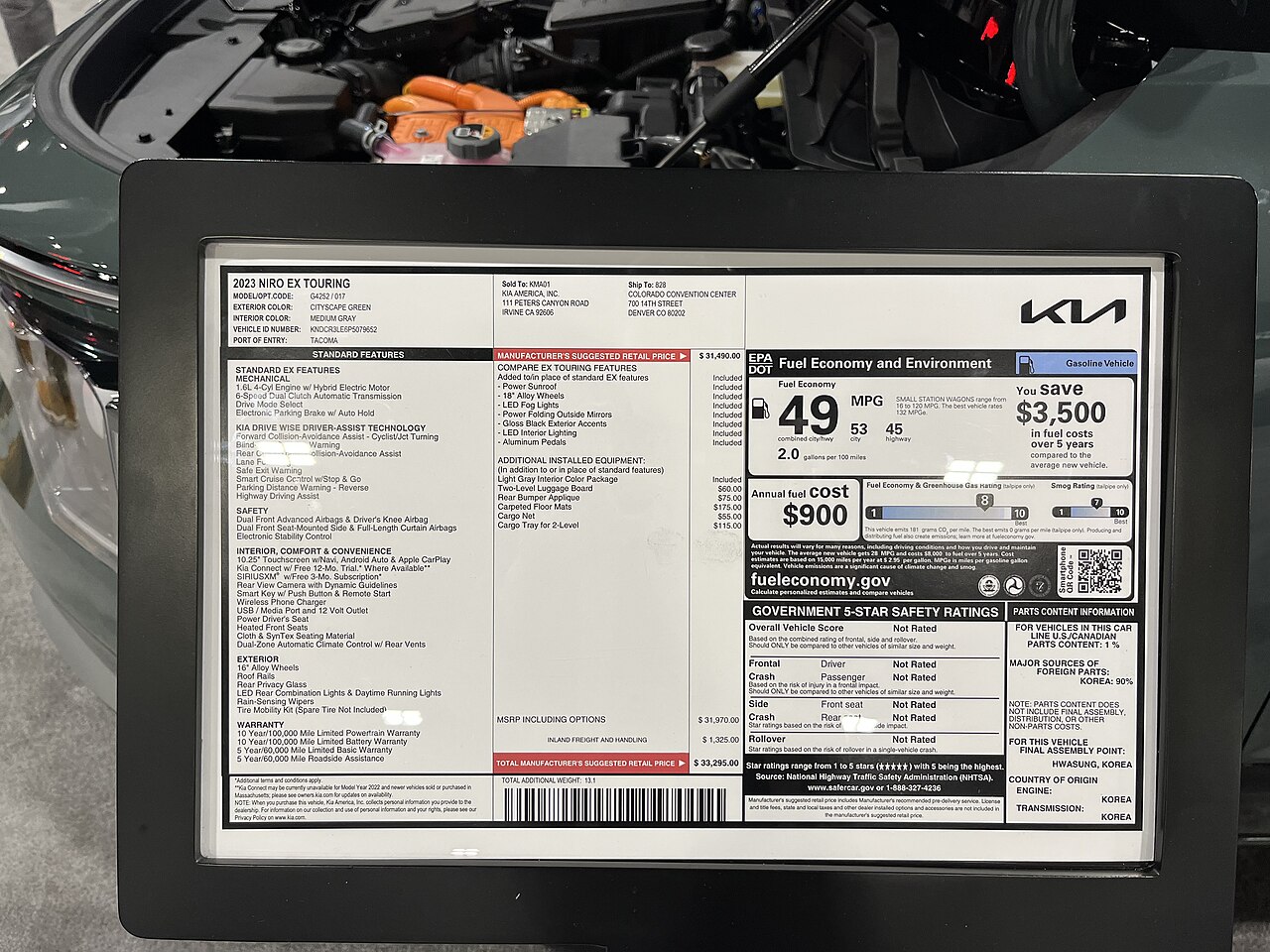
A display vehicle is a particular configuration
An auto-show vehicle may carry a familiar model name while presenting a specific trim, equipment package and powertrain. A window sticker helps connect the object in front of you with documented details about that configuration. Its separate areas can identify equipment, manufacturer pricing information, fuel-economy estimates and other labeled information. Ford’s official window-sticker resources and EPA’s fuel-economy label explanations provide primary references for those document types. The example in this feature is an invented label-reading exercise. The exercise connects each field with the configuration or estimate it is designed to describe.
Match the document to the displayed vehicle
Begin with the identifying description on the document: model year, model, variant and any supplied vehicle identifier. A general brochure can cover several configurations, while a sticker may describe one vehicle. In a sample exhibit, the Harbor sedan appears in a Touring configuration beside a brochure covering both Touring and Utility versions. A feature shown as available in the brochure need not be included on this particular display car. The relationship between document and object is therefore the first question. If the exhibit uses a concept vehicle or a generic information panel, describe it as such rather than assuming it has a retail configuration record.
Separate standard equipment from listed options
A sticker’s equipment sections can distinguish what is included in the identified configuration from additional listed items. Use the labels actually printed on the document rather than assuming every attractive feature is standard across the whole model range. In the Harbor example, the display document identifies one audio system in the standard-equipment area and a different interior package in the options area. That is evidence about the listed configuration. It would not establish that the package is available for every other variant. Preserve the wording and category when taking notes, especially if a presenter is describing a broader range than the vehicle physically shown.
A package name can conceal several details
An equipment package can group multiple features under one heading. Its name is an identifier, not a complete explanation of its contents. Suppose the Harbor label lists a Winter Comfort package but the exhibit panel does not define it. The useful follow-up is which documented features belong to that package for this model year and configuration. Guessing from the name could incorrectly add an item the package does not contain. A nearby vehicle with a similar package name could also use different contents. The specific manufacturer documentation establishes the relationship; familiarity with a name cannot replace that edition and configuration context.
Keep pricing fields in their document role
A manufacturer’s suggested price, a listed option amount and a destination line are labeled parts of a document, not automatically the complete terms of a transaction. Ford’s showroom information distinguishes base MSRP, destination charges and options, and separately describes dealer accessories. For this exhibit-reading exercise, the task is to identify the category of each line and which vehicle it describes. No current amounts are needed. In the label, combining the printed categories might reproduce a printed total, but that arithmetic would not establish taxes, fees or an individual agreement. Read the document’s own heading before treating any number as answering a different question.
The fuel-economy panel uses defined estimates
EPA’s vehicle-label explanations identify different measures and estimates, including energy use and range for electric vehicles. A label’s units matter: a distance figure and an energy-use figure describe different relationships. Its explanatory text also gives context for cost estimates. At a show, read the unit and the description alongside the large number rather than copying the number alone. In the Harbor record, a note saying energy use per stated distance is more informative than an unlabeled figure. A standardized estimate is useful comparison information within its stated framework; it does not document the conditions of one visitor’s future journeys.
Do not merge neighboring information panels
A manufacturer sticker, an exhibit sign and a dealer-added panel can sit close together while describing different things. Their physical proximity does not make them one document or give them the same issuer. In the exhibit, a large wall sign celebrates the Harbor range, while the sticker identifies the Touring display car. Record which source supplies each claim. The same distinction helps with an image: a photograph of a trim badge does not establish the full options list. When a detail remains unclear, keep it as a question attached to the particular document instead of filling the gap from another vehicle’s presentation.
Create a configuration note that remains useful
A compact exhibit record can identify the vehicle, the document issuer, one standard feature, one separately listed item and the unit attached to any estimate that interests you. That makes later reading more precise without turning the note into a buying recommendation. If two show vehicles appear similar, their document identities can explain a difference the exterior does not reveal. At the next auto exhibit, ask which printed record describes the car in front of you and which information applies to the wider range. The answer provides a factual foundation for understanding the display before discussing impressions of its design.
Continue exploring
Explore related events
Current facts come from the directory. Follow the exact listing for admission, venue information and the official source.
Chicago Auto Show 2027 · Feb 13 – Feb 21, 2027 · scheduled · Check organizer for current admission availability
Sources and further reading
- Ford: Window sticker resources ↗
- Ford: Showroom pricing and equipment definitions ↗
- EPA: Electric vehicle label explanation ↗
Source review: 2026-10-12. Examples identified as hypothetical are original illustrations.
An independently researched feature. Worked examples are illustrative; photographs identify their archive or collection context.
Find your next event →