
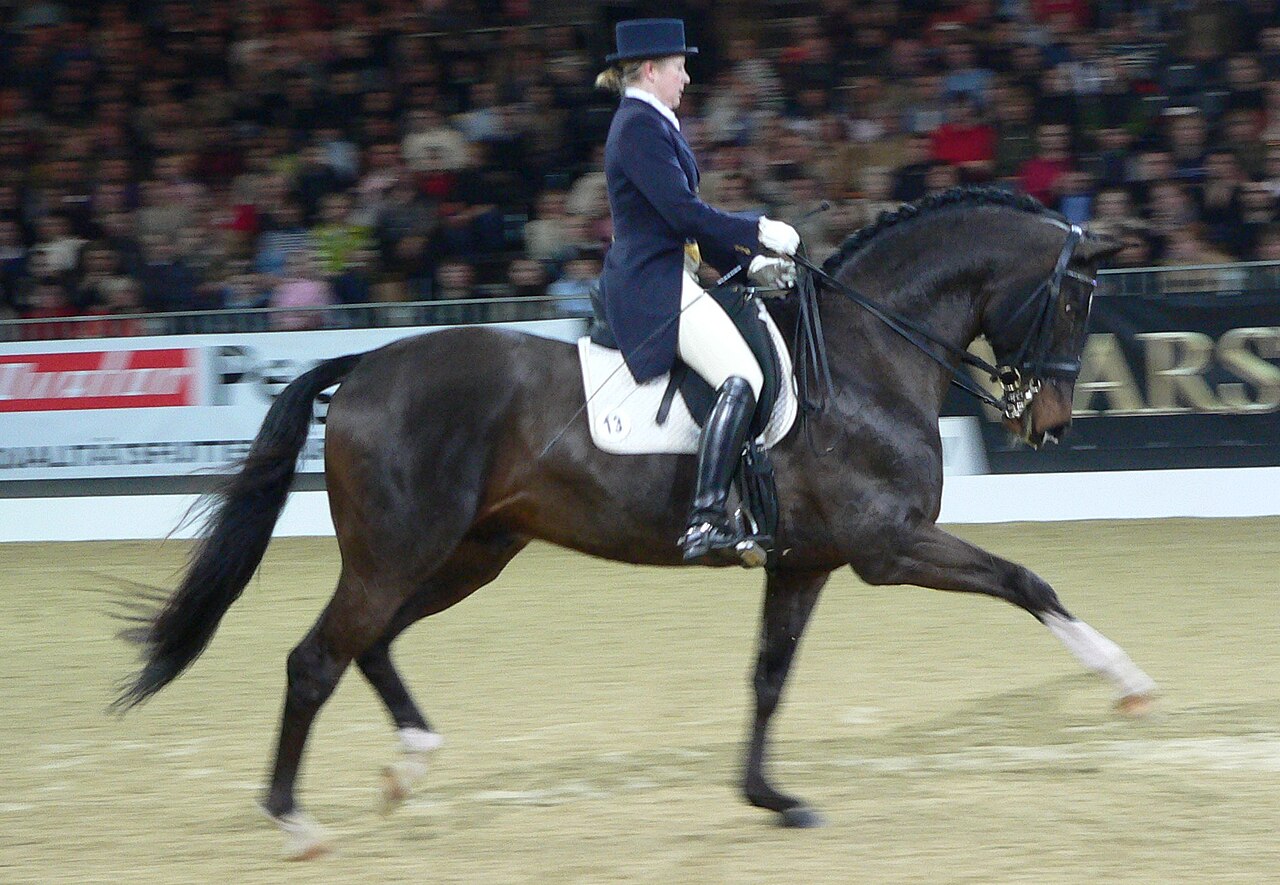
Read the discipline before the performance
An equine expo may place several demonstrations in one arena, making the program heading essential. A horse and rider entering the same space do not necessarily face the same task. US Equestrian organizes multiple disciplines, including dressage, hunter, jumping and reining, with distinct competitive frameworks. For a public demonstration, the first useful question is which framework the presenter is explaining. The answer changes what the audience should notice. A flowing sequence, a course of fences and a prescribed pattern can all produce compelling movement, but their purposes should not be collapsed into one general idea of “horse riding.”
Dressage gives the sequence meaning
US Equestrian describes dressage through exercises organized into tests, with musical freestyle as another form of presentation. A spectator can begin by distinguishing a test from an exhibition that borrows movements for educational purposes. The program's designation matters because a narrated demonstration may pause, repeat or isolate an element. That presentation is not automatically a scored test. Watch how the sequence is framed: does the announcer identify a test, a level, a movement or a freestyle? Recording that label helps explain the performance without turning your visual preference into a judging claim or assuming that music changes every display into a competition.
Hunter and jumping are not synonyms
Both disciplines can involve fences, but their competition frameworks differ. US Equestrian's discipline explanations provide the appropriate starting point for understanding the named event. For an expo visitor, the practical distinction is to avoid declaring that every round over fences is the same kind of result. A public presenter may discuss style, course execution or recorded outcomes within a particular discipline. Preserve the name used in the program and the criteria explicitly explained. If an exhibition combines elements, describe it as the announced demonstration instead of assigning an unprinted competitive class based on the arena's appearance.
Reining has its own pattern language
Reining is organized through defined patterns in its competitive setting. A public demonstration can explain selected elements of that structure without presenting a complete competition. The spectator's task is to connect the narrated element with the program's discipline, rather than to reconstruct a pattern or instruct a rider. A heading such as “reining demonstration” establishes the subject but does not report a score. If the presenter gives a result from a named event, attach that event and class to the number. The visible arena may remain the same while the performance's rules and meaning have changed completely.
Compare a fictional afternoon program
Imagine a hypothetical expo program with three items: a dressage movement explanation, a hunter demonstration and a reining pattern overview. The first isolates one element, the second introduces a discipline, and the third describes a sequence. None of those labels promises an official competitive result. A visitor's notebook could therefore use three columns: program title, structure explained and evidence shown. Under the first item, the note might say “one movement repeated with narration.” Under the third, it might say “presenter identified a pattern.” This comparison keeps the educational format visible and avoids judging three unlike demonstrations against one imagined standard.
Breed and discipline occupy separate columns
A breed name identifies one classification of the horse; a discipline identifies the activity being presented. They can appear together in an expo listing without being interchangeable. A program might introduce a breed through several activities or illustrate one discipline with horses identified by breed. Read both fields, and notice which one the session's explanation emphasizes. In a listing, “Breed E presentation: dressage demonstration” gives the audience two layers of information. Removing either layer changes the meaning. The catalog can tell you the named breed while the performance heading tells you which activity organizes what you see.
A demonstration edits the audience's view
Public demonstrations often concentrate attention on a few clearly explained features. Narration, repetition and camera close-ups can make an element easier to recognize than it would be during an uninterrupted competition. That is a strength of the educational format, but it should remain part of your account. A replayed moment is not a second competitive attempt unless the event identifies it that way. A slow explanation is not evidence that the discipline itself is slow. Note how the presenter has selected and framed the material. The form of the demonstration helps determine which conclusions the audience can reasonably draw.
Describe the program in its own terms
Afterward, write a sentence that includes the discipline, presentation type and one explained structural feature. “The dressage demonstration isolated a movement within a test context” is more accurate than “the horse won.” “The reining presenter explained a pattern” preserves the educational purpose. These descriptions do not require spectators to score a ride or evaluate an individual horse. They do require attention to the program's vocabulary. Once that vocabulary is clear, an equine expo becomes a set of distinct disciplines and presentation forms rather than a succession of performances whose differences are left unexplained.
Continue exploring
Explore related events
Current facts come from the directory. Follow the exact listing for admission, venue information and the official source.
World of Pets Expo 2027 · Jan 29 – Jan 31, 2027 · scheduled · Check organizer for current admission availability
Sources and further reading
Source review: 2026-10-12. Examples identified as hypothetical are original illustrations.
An independently researched feature. Worked examples are illustrative; photographs identify their archive or collection context.
Find your next event →