
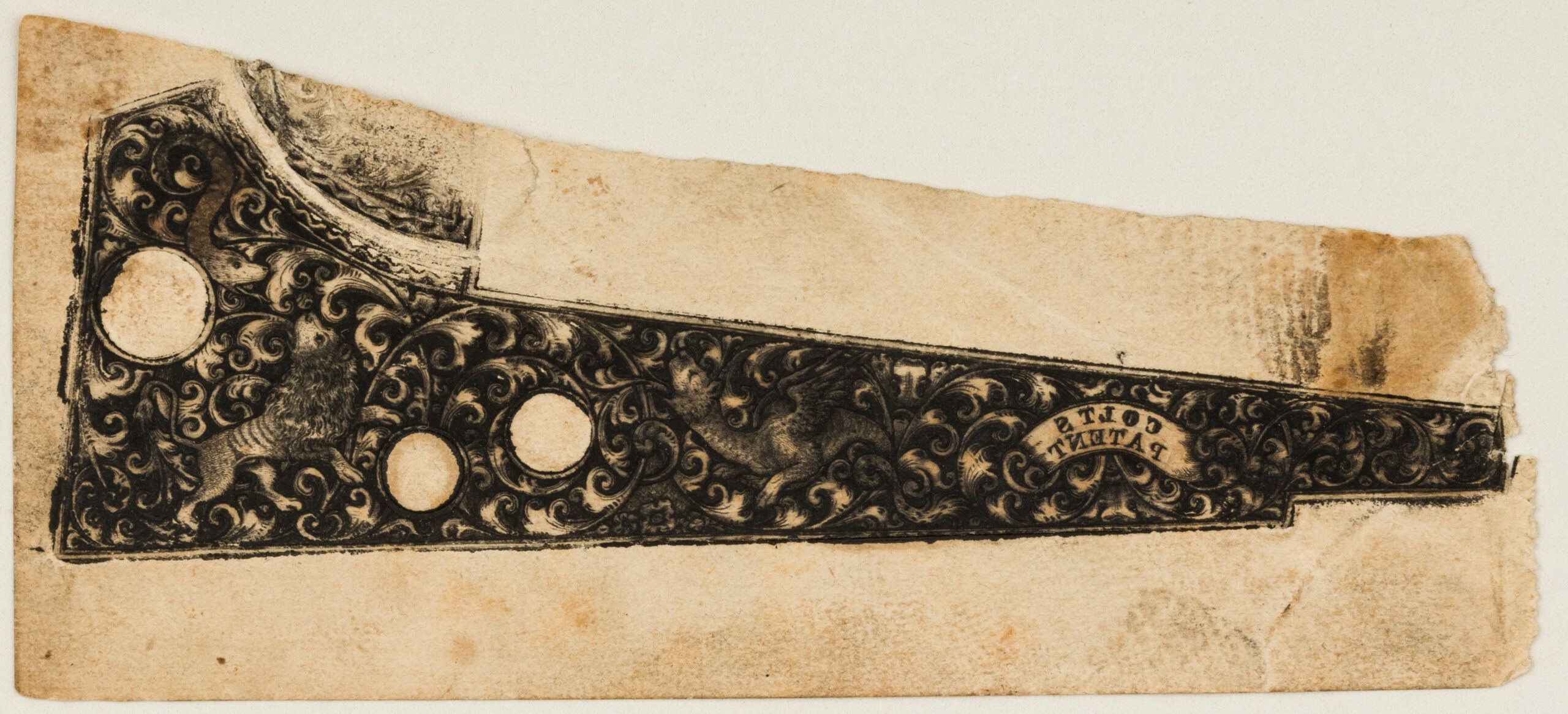
The unexpected object is a piece of paper
An antique-arms display can tell a compelling story without placing a complete firearm at its center. The Metropolitan Museum of Art holds an ink impression, or pull, from a gold-inlaid Colt revolver, dated about 1854 and associated with engraver Gustave Young. The museum says the original pistol is not known to survive. The paper therefore preserves evidence that cannot simply be checked against the complete object beside it. For an exhibition visitor, that reversal is worth pausing over: the fragile-looking record has survived where the substantial object may not have, making an impression itself the subject of close attention.
A record of ornament has its own identity
The Met catalogs the impression as ink on paper and supplies its own accession number, 2009.330. Those details identify a separate museum object, not merely an illustration attached to a revolver’s record. When a collector display includes a similar archival item, read its label independently. What is the material? What date is assigned to it? Which part of another object does it record? A drawing, a photographic print and an impression can all document decoration, but they are different kinds of evidence. Naming the medium helps a viewer understand what is actually present before interpreting what it may reveal.
The impression is not a complete portrait
The museum describes this pull as a record of decoration from a revolver frame. Its scope matters. A fragment of ornament can preserve a design relationship without documenting every surface, color or material of the lost object. This is an editorial inference from the limited form of the record, not a claim that the paper supplies a full reconstruction. At a display, resist mentally completing what is absent. Ask which features are visible in the surviving record and which require another source. The distinction lets a small archival object remain valuable without asking it to answer questions beyond the evidence it contains.
A pattern can travel beyond one workshop
The Met connects the design’s inspiration to a plate in an 1850 pattern book by the Zella engraver Gustav Ernst. That connection introduces another layer of exhibition history: printed designs could provide a shared visual vocabulary. Similar scrollwork therefore invites questions about training, sources and circulation as well as individual authorship. A visitor might compare the direction and arrangement of forms while keeping the museum’s interpretation attached to the comparison. The presence of a related motif does not, by itself, settle who decorated a different object. It gives the eye something specific to examine and the researcher a relationship to investigate.
Read a surviving decorated object alongside the record
For comparison, The Met’s separately cataloged Colt Model 1851 Navy revolver, serial number 2, identifies its engraving as attributed to Joseph Delany. The attribution is part of that object’s own record, not a name to transfer to the Young-associated impression. Looking at both illustrates how museums separate a surviving decorated object from an archival trace of another. Their materials and records support different questions. One can prompt attention to ornament on an actual surface; the other can show why a documentary fragment deserves a place in an exhibition. Similar subject matter does not make the objects or their credits interchangeable.
Give the archive room in the display
At a history-focused collector exhibition, a carefully labeled document can deepen a display rather than merely fill the space around a centerpiece. A visitor can leave with a record of the paper’s identity, the object it documents and the limits of that relationship. The accompanying high-resolution image reproduces the Met’s public-domain collection photograph of the impression; it is not a current show photograph. Sources were checked November 2, 2026. This feature concerns decorative art and exhibition interpretation. Its invitation is to look more closely at the quiet archival material that explains how a historical design is remembered when the original object cannot be seen.
How this article was prepared
This article used automated drafting and checks against the linked sources. Its photograph is identified and credited separately. Please use our correction link to report an error.
Continue exploring
Explore related events
Current facts come from the directory. Follow the exact listing for admission, venue information and the official source.
Crossroads of the West Gun Show — Las Vegas — 2026 (2026-11-21) · Nov 21 – Nov 22, 2026 · scheduled · Admission announced; organizer says tickets will be available soon
Crossroads of the West Gun Show — Tucson — 2026 (2026-11-21) · Nov 21 – Nov 22, 2026 · scheduled · Admission announced; organizer says tickets will be available soon
Pasadena Gun Show — 2026 (2026-11-21) · Nov 21 – Nov 22, 2026 · scheduled · Public visitor admission announced; check organizer for current availability
Pittsburgh Gun Show — 2026 (2026-11-28) · Nov 28 – Nov 29, 2026 · scheduled · Public visitor admission announced; check organizer for current availability
Sources and further reading
- The Met: ink impression associated with Gustave Young, 2009.330 ↗
- The Met: Model 1851 Navy revolver serial number 2, engraving attributed to Joseph Delany ↗
Source review: 2026-11-02. Examples identified as hypothetical are original illustrations.
An independently researched feature. Worked examples are illustrative; photographs identify their archive or collection context.
Find your next event →










