
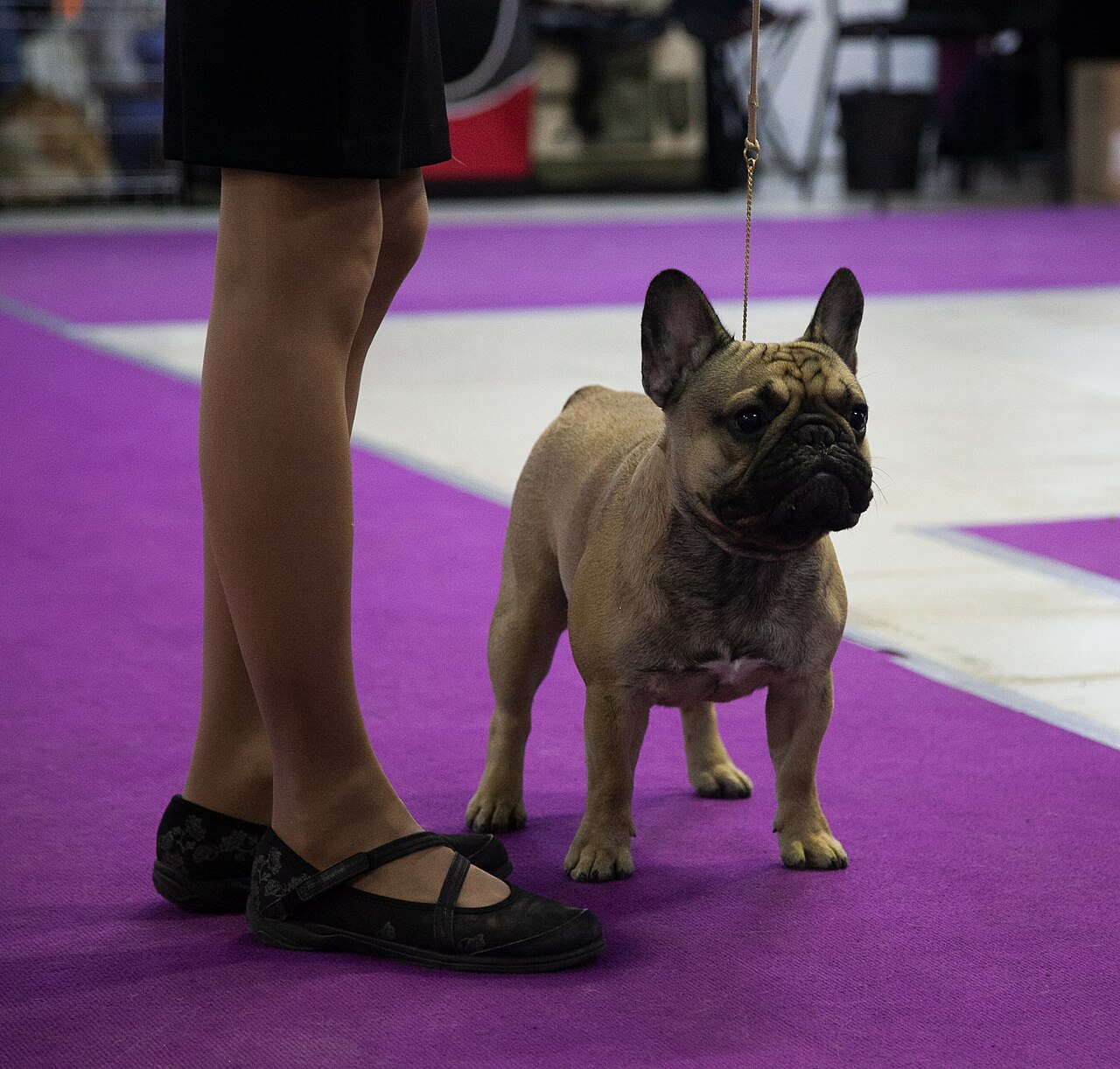
A result needs its stage
A dog-show program can contain several winners without contradicting itself. Breed judging, group judging and Best in Show answer different questions within the same competition. At a public exhibition, a ribbon or announcement becomes more useful when you know which stage it belongs to. The American Kennel Club's explanation of all-breed conformation shows provides one specific model: a Best of Breed winner can advance to a group, and group winners can advance to Best in Show. That progression is a framework for reading results, rather than a universal description of every canine event or every award printed in its catalog.
Breed judging is the first frame
Conformation judging evaluates dogs against the standard for their own breed. This matters because a spectator might otherwise assume that all dogs are being compared against a single ideal appearance. Start with the breed heading in the program, then identify the award attached to an individual entry. A result for a class within that breed is more specific than the final breed-level result. If the catalog lists several classes and sexes, preserve those distinctions in your notes. Reducing every ribbon to “won the breed” removes information and can make a later result appear inconsistent when it describes a different stage.
Groups organize the next comparison
In the AKC all-breed structure, seven groups organize breed winners before the final competition. The group heading supplies the context for a group placement; it is not the name of an additional breed. Imagine a result sheet with a breed name in one column and a group placement in another. Those columns document a progression, not two unrelated competitions. The dog has reached a wider stage while still being evaluated through its breed's standard. Keep the sponsoring organization visible when explaining this structure, because another organization may use different divisions, award names or procedures for its own shows.
Best in Show has a defined field
Best in Show is the final comparison among the group winners in this particular structure. It does not mean that every dog entered the final ring together, or that the winner is objectively best at every possible canine activity. The award belongs to conformation at that show. An agility result, an obedience title and a conformation award describe different performances or evaluations. If a public expo presents several activities, attach the discipline to each result. That small habit prevents a broad phrase such as “champion dog” from carrying more meaning than the underlying record can support.
Follow a fictional entry
Consider a hypothetical dog named Fern. The catalog places Fern in Breed A. A result then names Fern Best of Breed, followed by first place in the relevant group. Fern subsequently appears in the Best in Show lineup but does not receive that final award. All three observations can be correct. Fern's breed win and group win still exist after another dog receives Best in Show. A useful note would read: “Fern: Best of Breed; group first; participated in final comparison.” Writing only “Fern lost” discards most of the competition's structure and misrepresents the earlier results.
Read the catalog as a map
A catalog helps connect an entry number, breed heading and result without requiring the spectator to judge the dog. Begin with the printed section title. Locate the entry number in that section, and then match the announced award to the correct stage. If a number appears elsewhere, do not assume it identifies the same entry without checking the catalog's numbering system. Catalogs and live announcements serve different purposes: one organizes the field, while the other reports what has happened. A marked catalog can preserve both, provided that your handwriting distinguishes a printed entry from an observed result.
Separate the show from a series
Several shows can share a building or weekend while maintaining separate judging and results. A winner on one day is not automatically the winner on another. Likewise, a specialty show centered on one breed is different from an all-breed show, even when visitors encounter both in the same hall. Record the actual show name beside a result, not just the venue or weekend date. In a notebook, two columns labeled “Show One” and “Show Two” are clearer than overwriting yesterday's award. This approach treats the event record as a sequence rather than a single permanent ranking.
Make the announcement intelligible
After watching a judging stage, try describing its outcome in one accurate sentence: name the show, discipline, stage and award. For the example, “Fern won its group at Show One and advanced to the conformation final” conveys considerably more than “Fern is the best dog.” The goal is neither to second-guess the judge nor to rank breeds yourself. It is to understand what the public program has actually reported. Once the progression is clear, the movement between rings and the accumulation of awards become part of a coherent story instead of a series of disconnected ribbons.
Continue exploring
Explore related events
Current facts come from the directory. Follow the exact listing for admission, venue information and the official source.
World of Pets Expo 2027 · Jan 29 – Jan 31, 2027 · scheduled · Check organizer for current admission availability
Sources and further reading
Source review: 2026-10-12. Examples identified as hypothetical are original illustrations.
An independently researched feature. Worked examples are illustrative; photographs identify their archive or collection context.
Find your next event →