
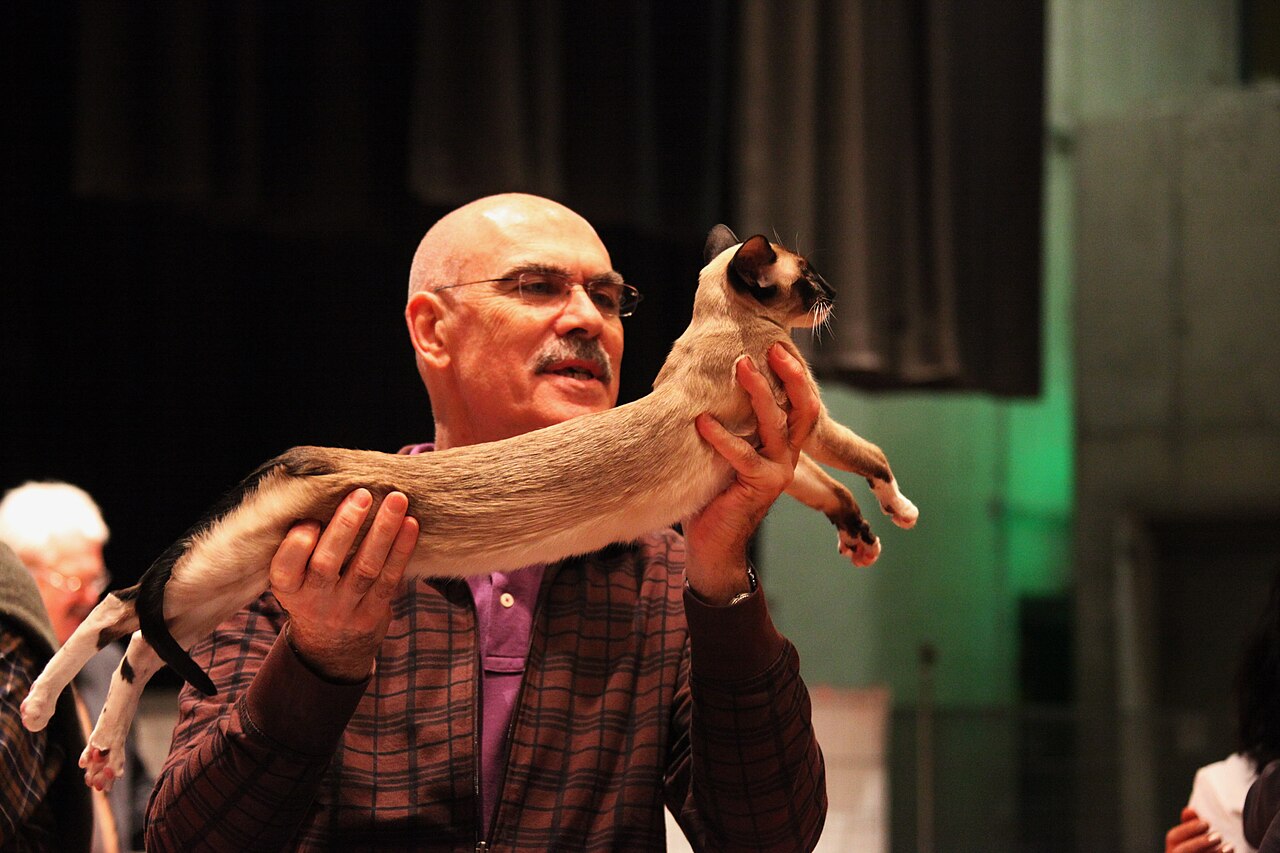
A cat show contains several layers
A cat-show label can identify a breed, a competition class, an entry number and a judging ring. Those fields answer different questions. The breed describes the cat's classification within the show's system; the class places the entry in a particular competition; the number connects it with the catalog; and the ring identifies a judging context. The Cat Fanciers' Association explains its shows as a series of individual judging rings, each with its own judge and results. A visitor therefore needs more than a breed name to understand an announcement. Reading the layers prevents one label from being mistaken for the whole result.
Breed is not the class
A breed name does not by itself explain where the cat competes. CFA's introductory material distinguishes competition categories such as kittens, championship, premiership and household pets. Those names belong to the organization's show structure, and the applicable rules supply their eligibility details. A catalog may place cats of one breed in different categories. Conversely, a category can contain entries from several breeds. When describing a display, copy the breed and class into separate fields. This simple separation preserves the catalog's meaning without requiring you to infer age, reproductive status or eligibility from the cat's appearance alone.
Rings have independent results
At a CFA show, individual judging rings can produce different outcomes. A cat receiving an award in one ring is not guaranteed the same placement in another. For a spectator, the ring number is therefore part of the result's identity. If two announcements name different winners, first ask whether they came from the same ring and category. There may be no contradiction. The show is presenting multiple evaluations under its structure. A result notebook that has one blank space for “the winner” is too small for this information; separate ring columns preserve the distinctions that the actual program makes.
An entry number is a reference
Numbers help link a cat with the catalog and announcements. They do not inherently describe quality, breed or ranking. A low entry number is not evidence of an early placement, and a high number is not an award position. Locate the number in the appropriate catalog section before attaching any conclusion to it. If the number appears on a cage card, it may function as an identifier within that show. It should not be treated as a permanent identifier across every exhibition. The useful question is which record system the number belongs to, and what information that system connects.
Decode a fictional catalog line
Imagine a deliberately hypothetical entry: “Entry 42 — Breed B — Kitten category — Ring 3 final.” The line says that the entry belongs to a named breed, competes in a particular category and appears in one ring's final. It does not state that the cat won every ring, that it is the show's overall winner, or that a final is the same as a class designation. If another line places Entry 42 in Ring 5 with a different result, preserve both. Writing each outcome beside its ring creates a coherent record rather than forcing several independent judgments into one conclusion.
Read the final's heading
A final announcement becomes intelligible when its category and ring are visible. The word “final” alone is incomplete. Check the heading on the official result or the category stated by the announcer. A kitten final and a household-pet final are not the same field of entries. Even when the presentation style looks similar, their labels retain distinct meanings. A visitor explaining the scene to a companion can name those headings before discussing a placement. This approach makes the event understandable without pretending to assess the cats against the judging criteria or translating an impression into an award.
Separate description from inference
Coat length, pattern and visible color can be useful observations, but they do not replace the official classification. A cat that resembles a familiar breed in a photograph may have a different catalog designation. Descriptive notes can therefore use two columns: “what the label states” and “what I can see.” The first preserves the show's information; the second records your visual interest. If a label is unavailable, leave that field unresolved. This distinction is especially useful at a public expo where an educational animal display and a formal show can occupy neighboring spaces while serving different purposes.
Build a readable account
A clear account of a cat-show result includes the organization or show, entry reference, category, ring and reported award. It need not contain every catalog detail. For the example, “Entry 42 reached the kitten final in Ring 3” is concise and appropriately limited. Comparing it with a Ring 5 result then becomes possible because both records have a defined context. The same method works when examining an archived catalog after the event. Instead of flattening a busy show into a single winner, you can follow the parallel competitions that make its labels and announcements meaningful.
Continue exploring
Explore related events
Current facts come from the directory. Follow the exact listing for admission, venue information and the official source.
World of Pets Expo 2027 · Jan 29 – Jan 31, 2027 · scheduled · Check organizer for current admission availability
Sources and further reading
Source review: 2026-10-12. Examples identified as hypothetical are original illustrations.
An independently researched feature. Worked examples are illustrative; photographs identify their archive or collection context.
Find your next event →