
Two kinds of reading
An aquascaping exhibit can be read as a visual composition and as a stated representation of a habitat. Those readings overlap, but they ask different questions. The first concerns what the arrangement makes visible: foreground, mass, contrast, space and focal emphasis. The second concerns what the accompanying documentation claims about a particular environment. The Aquatic Gardeners Association's current international contest guidelines distinguish artistic categories from the specific requirements of a biotope representation. An expo visitor can use that distinction without treating every aquarium as an entry in that contest or assuming that an attractive composition establishes the accuracy of a habitat claim.
Begin with the viewing frame
The front of the display creates a frame through which the arrangement is presented. Notice where the visible scene begins and ends, and whether the explanatory photograph uses the same viewpoint as the live exhibit. An oblique photograph can emphasize depth differently from a straight-on view. A close-up may omit most of the arrangement. In a comparison, one image shows the full tank and another shows only a cluster of plants. They provide different evidence. Reading the composition starts with knowing which frame you are looking through, rather than imagining that every photograph represents the complete scene equally.
Foreground is a spatial role
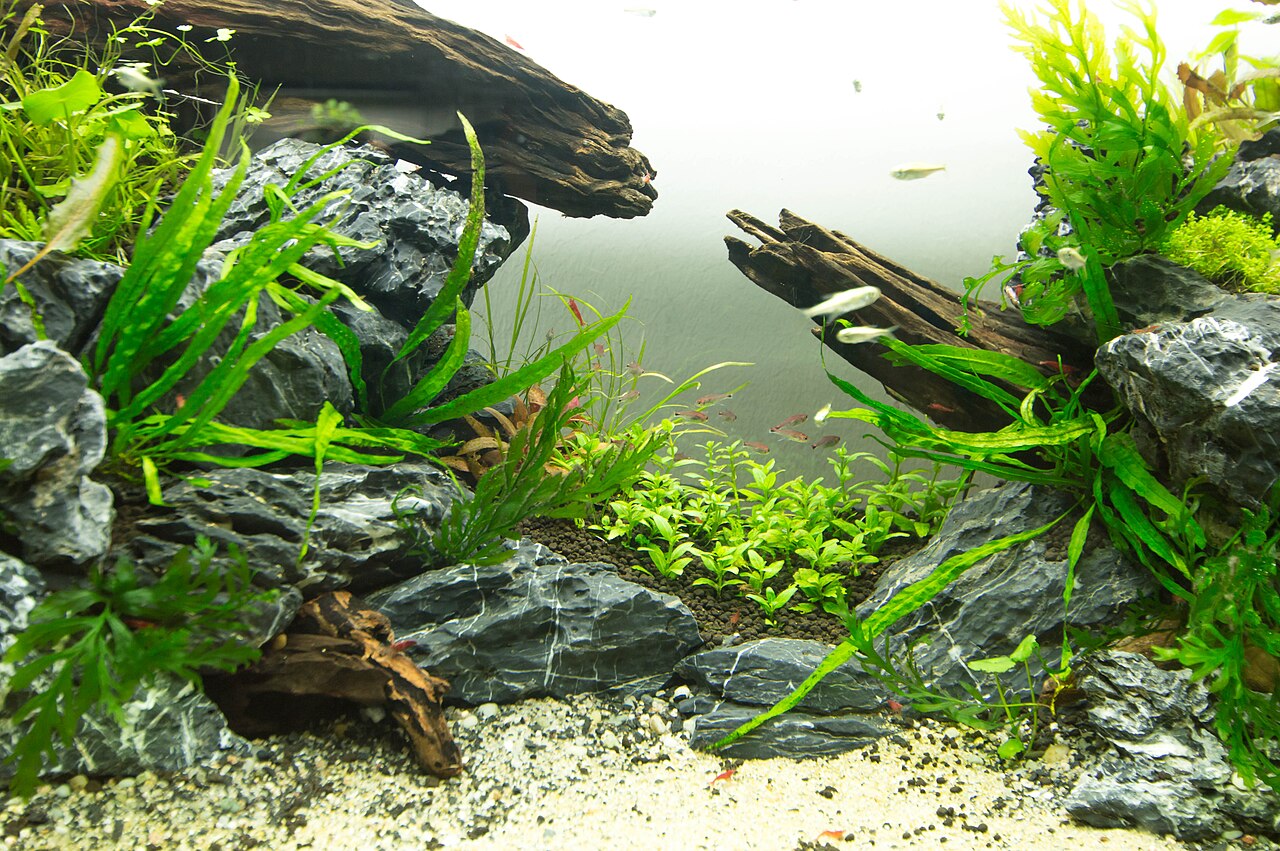
Foreground describes the area closest to the viewing position in the composition. It is a relationship, not a guarantee that a particular plant or material belongs there in every exhibit. A low visible element may let the eye move into a deeper area; a dense mass may intentionally interrupt that movement. Describe what the arrangement does before assigning a stylistic label. “The open foreground reveals a narrow space between two masses” is a concrete observation. “This is a natural river” is a larger claim that requires evidence beyond the visual arrangement, especially when the exhibit names a specific place.
Structure directs attention
Large shapes, repeated lines and contrasting surfaces can guide the eye through a display. A diagonal arrangement may emphasize movement across the frame, while two separated masses may create a central opening. These are compositional observations, not judgments about an animal's welfare or the exhibit's maintenance. The AGA guidelines include visual composition among their evaluation concerns, but a visitor can describe structure without assigning a contest score. Look for the relationship between the dominant shape and smaller details. A tiny accent may be noticeable precisely because most of the surrounding space has a different texture or tonal value.
A biotope claim names a reference
The AGA's biotope guidance concerns representing a particular natural environment, with documented relevance of the composition's elements. A location name therefore does more than decorate a label. It states a reference against which the representation can be understood. Read whether the label identifies a broad region, a particular water body or a more specific habitat. A general “river-inspired” description makes a different claim from a documented reconstruction of a named locality. The level of specificity should remain visible in your account. A visually convincing scene and a well-supported geographical interpretation are related achievements, not the same one.
Compare two fictional exhibits
Imagine Display A labeled “Mountain-stream-inspired composition” and Display B labeled “Representation of Habitat F,” accompanied by a reference map and an explanation of selected elements. Display A invites an artistic reading through its inspiration; Display B makes a more specific representational claim. A visitor could compare their foreground spacing and dominant shapes using the same visual vocabulary. Assessing the habitat claim, however, requires reading Display B's documentation. A beautiful photograph of either tank does not settle that second question. This example separates the evidence available in the image from the evidence supplied by the label.
Follow the label's scale
A photograph can make a modest display resemble a much larger landscape. That visual effect does not establish the scale of the environment being represented. Check whether the caption gives physical dimensions, a viewpoint or an explanation of the composition's intended scale. In a notebook, “appears spacious in the front photograph” is a visual response; “represents a large natural habitat” is a factual claim. Keeping the two separate helps you appreciate visual illusion without mistaking it for geography. It also makes side-by-side comparisons fairer when displays are photographed from different distances or cropped to different boundaries.
Preserve both explanations
A useful account can hold an aesthetic response and a documentation note together. For example, an exhibit might be described as “an open foreground leading toward two dominant forms; the label identifies a named habitat and supplies its references.” The first clause reports visible structure, while the second reports the curatorial claim. Neither erases the other. At a public aquatics exhibition, this approach makes the display richer: visitors can appreciate composition, notice how it is framed and understand the scope of the habitat statement. The result is a more precise interpretation than treating every pleasing aquarium as an automatically verified natural scene.
Continue exploring
Explore related events
Current facts come from the directory. Follow the exact listing for admission, venue information and the official source.
World of Pets Expo 2027 · Jan 29 – Jan 31, 2027 · scheduled · Check organizer for current admission availability
Sources and further reading
Source review: 2026-10-12. Examples identified as hypothetical are original illustrations.
An independently researched feature. Worked examples are illustrative; photographs identify their archive or collection context.
Find your next event →